
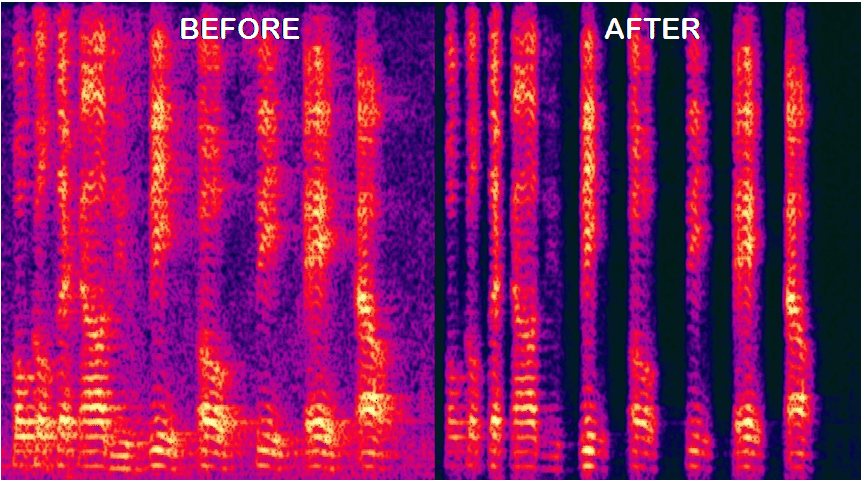
Dereverberation is used in hands free communication systems where environmental echo affects speech intelligibility and speech recognition.
- Ideal for laptops, tablets and videoconferencing systems
- Tested with real world voice recordings
- Handles both tonal and impulse interference at 8kHz and 16kHz sampling rates and up to one second of reverberation
VOCAL’s Dereverberation software library is modular and optimized for DSPs and conventional processors from TI, ADI, ARM, AMD, Intel and other leading vendors. Our expertise in the design, implementation and configuration of mobile, network, and telephony solutions will help you bring your voice application to market rapidly and efficiently. Contact us to discuss your specific speech application requirements.
Speech Dereverberation
Speech Dereverberation is important in free-space systems, e.g. laptops, tablets and videoconferencing, where environmental echoes or speech reverberation can disrupt conversations. With these systems, it is not the responsibility of the user to move closer to the microphone, but for engineers to develop speech enhancement systems that provide the freedom users desire in these environments.
In any environment where the speaker is not located near the microphone, dereverberation of speech signals can improve speech intelligibility and speech recognition by removing the environmental effects of the room impulse response. Similar to acoustic echo cancellation, speech dereverberation models the room impulse response transfer function and filters it from the received microphone signal. However, in this case the problem is more complex because we do not have access to the original sound source.
A sound source located a distance from a microphone will have its direct path signal arrive at the microphone and then reflections of the original signal will be captured. As the distance from the source to the microphone increases, the signal to reverberation ratio and, as a result, the effect of reverberation will also increase. To a listener, late reflections sound like noise while early reflections introduce speech coloration and distance perception.
Dereverberation Software
VOCAL’s Dereverberation software has been studied using real world voice recordings and comprehensive computational modeling. Tests demonstrate the algorithms can effectively handle both tonal and impulse interference at 8kHz and 16kHz sampling rates with reverberation of up to one second.


Our speech dereverberation software may be licensed by developers as a standalone algorithm or as part of our comprehensive Voice Quality Enhancement and Speech Recognition solutions. VOCAL offers a complete range of ETSI / ITU / IEEE compliant algorithms, including speech dereverberation and many other standard and proprietary algorithms. The software libraries are modular and can be executed by developers as a single task under a variety of operating systems or standalone with its own microkernel.
- Voice Activity Detection for Dereverberation of Speech
- Reverberation Cancellation versus Suppression
- Combination of dereverberation and adaptive beamforming
- Echo Cancellation Design

VOCAL’s solution is available for the above platforms. Please contact us for specific supported platforms.