Call Us Today: +1-716-688-4675

Echo Cancellation

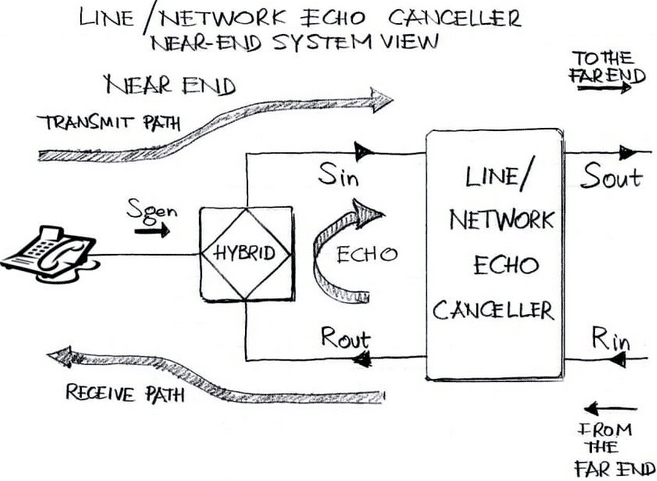
Echo Cancellation is the reduction of the reflected copies of a direct path wave in a signal. In telephony, the source of these reflections can be generated electrically due to an impedance mismatch in the transmission path or as a result of an acoustic and/or mechanical coupling between a loudspeaker and a microphone, usually because they are in the same physical enclosure. A Line Echo Canceller (LEC) is used to address impedance mismatch; whereas, for acoustic/mechanical coupling an Acoustic Echo Canceller (AEC) is required.

Software Licensing for Echo Cancellation source code or binary

VOCAL’s Echo Cancellation library includes Line, Digital, and Acoustic Echo Cancellation software to provide superior speech enhancement in a wide range of VoIP, Voice, and telephony applications. VOCAL has extensive experience in the design, development, integration, and configuration of echo cancellation algorithms for many applications and different platforms.

Line Echo Canceller

G.168 Line Echo Canceller algorithms remove echos from line circuitry

Line echo cancellers are voice operated devices placed in the 4-wire portion of a circuit (which may be an individual circuit path or a path carrying a multiplexed signal) and are used for reducing the echo by subtracting an estimation from the circuit echo. They may be characterized by whether the transmission path or the subtraction of the echo is by analogue or digital means. For more information about standard implementations:

Acoustic Echo Canceller

Acoustic Echo Cancellation algorithm for improved speech enhancement
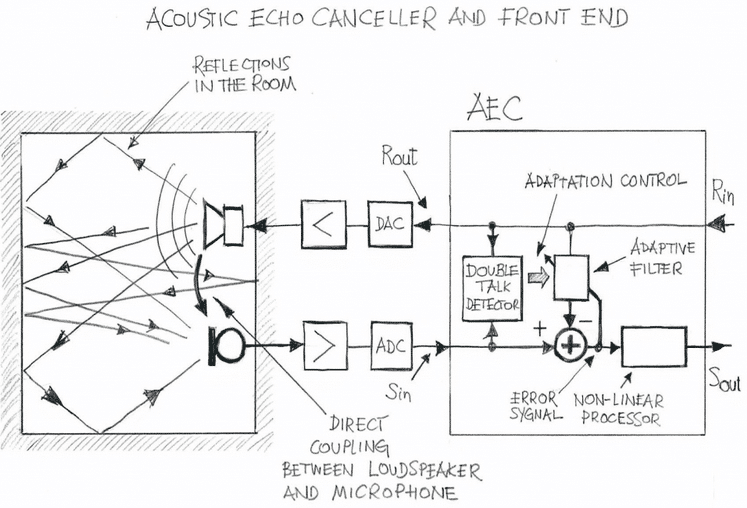
Acoustic Echo Cancellation is an essential part of providing speech enhancement (or voice quality enhancement) to any telephone communication. Acoustic echo canceller (AEC) software operates on the digitally sampled audio signals of the communication device. The transfer function of the acoustic environment from the loudspeaker to the microphone on the device is estimated to cancel the received echoes from the microphone signal.

Adaptive Filters

An adaptive filter is used in echo cancellation to accommodate the time varying nature of the echo path. The filter learns the path when the far-end speaker is talking and the near-end speaker is silent and adjusts its coefficients (transfer function) according to the algorithm optimization criterion.

Echo Tail Length

Echo tail length is considered the length of the impulse response of the echo path. The required length of the tail is dependent on the application. For line echoes the impulse is generally in the range of 8 to 32ms, while acoustic impulse responses can be on the order of  100ms.

Double-Talk Detectors

For an adaptive filter to learn the echo path it must have an undisturbed reference signal to adapt to. Unfortunately, in full-duplex communications, this scenario cannot be guaranteed as the near-end speaker may want to interrupt the far-end speaker. In other words, the near-end and far-end speakers will be talking simultaneously (double-talk), resulting in disturbances in the reference signal. These disturbances will result in divergent behavior of the adaptive filter and double talk detection is required to slow adaptation of the filter and prevent divergence.

Non-Linear Processing

Non-linear processing is the removal of residual echo left by the adaptive filter. Residual echoes are the un-modeled components of the echo path. Most adaptive filters are linear and can only cancel the linear portions of the echo path. Thus the nonlinear portions cannot be removed via the adaptive filter and a residual echo suppressor follows the filter to handle the nonlinear portions of the echo that remain.

Dereverberation

Reverberation is the multi-path propagation of the desired speaker to the receiving microphone. There are multiple sources of speech degradation which include additive noise sources and the acoustic impulse response of the room.  Additive noise sources are assumed independent of the desired speaker, while reverberation is dependent.  Noise reduction algorithms address additive noise sources, while dereverberation processing handles reflections.

Licensing

VOCAL’s echo cancellation software may be licensed as source code or binary with custom solutions available to meet unique application requirements. Our embedded software libraries provide a complete range of ETSI / ITU / IEEE compliant algorithms, including echo cancellation, optimized for execution on ANSI C and leading DSP architectures. These libraries are modular and execute either standalone with their own microkernel or as a single task under various operating systems.

back to top

Common Uses:

Speech Recognition Systems

Speech recognition is used in many man machine interfaces where the spectral characteristics of the speaker’s voice are important for these algorithms to recognize and interpret the words. The speaker may need to communicate with a speech recognition system in dynamic and often noisy environments and acoustic echo cancellation is used to maintain spectral characteristics in the voice signal.

In these situations, the impulse response (echo path) is very different from that of a typical office environment. Because of this, an adaptive algorithm will provide better overall speech enhancement for active noise control in varying conditions. AEC along with noise reduction is used to enhance the quality of the received voice signal while maintaining the spectral characteristics.

back to top

Laptop VoIP Systems (Soft Phones)

In multimedia systems, such as a laptop computer, the camera and microphone are sampled by a device separate from the one distributing audio to the loudspeakers. In fact the laptop could have external speakers and other third party devices plugged in. Regardless of the configuration, acoustic echo cancellation will be needed to deal with inherent system issues as well as handle the acoustic coupling. To avoid frustrating users of these systems, it is important that conversations be as clear and intelligible as possible.

All laptops are not created equal. Manufacturers (even the same manufacturer) may use different designs and components which affect the implementation, response times, and other characteristics of the computer system. Another consideration for laptops (and desktops) is the application may not be running on a dedicated platform; other high priority tasks can preempt the application and disrupt AEC algorithm performance. Moreover, if separate clocks are used in the speaker and microphone subsystems, synchronizing the sampling rates of the loudspeaker and microphone will be necessary to handle acoustic coupling. VOCAL’s AEC software solutions are designed to effectively handle system response variations and phase fluctuations adaptable to many devices and configurations.

back to top

Home Control, Security, and Patient Care Systems

Home control and security systems are becoming more common and many hospitals and long term/elder care facilities have upgraded their communication systems. These systems have come to rely on hands-free devices where clear intelligible speech  is important to facilitate often time-critical and emergency communications with individuals in a remote location.

For this scenario, the near-end speaker (resident or patient) will most likely not be located near the loudspeaker and microphone. For the near-end speaker to be heard and speech to be captured clearly, the gain on both the loudspeaker and microphone will be set high. Unfortunately this creates a particularly harsh echo environment where the acoustic coupling will be strong with nonlinear echoes present. The main challenge for the system designer is to handle the near- to far-end speaker ratio (NFR). The NFR will be much less than 0dB and during double-talk (both near- and far-end speakers talk simultaneously), the echo signal will swamp the near-end signal.

In this application double-talk detectors can be extremely unreliable; fortunately the divergence caused by the near-end speaker will not be as severe. Since the echo path is constantly changing, the convergence of a double talk detection algorithm cannot be guaranteed. To address these challenges, VOCAL has implemented a two-path echo canceller as a simple, but effective way to improve the system performance for handling doubletalk and varying echo path.

back to top

Active Noise Control in MRI

For patients undergoing magnetic resonance imaging (MRI), technicians need to issue directions and at times reassure an anxious patient. For safety, the MRI technician sits in a separate control room while the patient lies isolated in the MRI enclosure. Often patients may be nervous about the procedure and sometimes overwhelmed by the unfamiliar machinery and noise. To complete the procedure quickly and efficiently, the patient needs to be able to clearly hear, understand, and follow directions while the technician needs to address any questions or concerns of the patient.

For the patient to hear and be heard clearly, the gain on both the loudspeaker and microphone will be set relatively high. Unfortunately the MRI enclosure and other hard surfaces in the room create a particularly harsh echo environment for active noise control where the acoustic coupling will be strong with nonlinear echoes present.  In addition, the background noise generated by the rotating scanner creates a modulated noise spectrum. In other words, the level of background noise changes constantly at the rotation rate of the scanner. Standard single channel spectral subtraction is neither sufficient nor effective in this application.

For better overall speech enhancement, acoustic noise cancellation removes scanner noise signals captured by a separate microphone; an adaptive acoustic echo canceller addresses the impulse response within the enclosure; while noise reduction processing reduces the residual background noise. VOCAL’s AEC software provides superior voice quality enhancement for communications between the patient and technician during an MRI.

back to top

Active Noise Control in the Cockpit

For small private planes, commercial airliners, and especially military aircraft and helicopters, cockpits can be very noisy environments. These systems rely on active noise control to enhance voice quality for effective communications between pilots to other pilots or air traffic controllers in time-critical and emergency situations.

Reflections from metallic and other hard surfaces in the cockpit create an impulse esponse (echo path) that is very different from that of a typical office environment. In addition to double talk where both near- and far-end speakers talk simultaneously, these systems are expected to perform acoustic echo cancellation in harsh environments with significant echo and noise from the engines and aircraft vibrations. For better overall speech enhancement, an adaptive acoustic echo canceller is used to address the acoustic coupling. In addition, within the headset noise reduction processing is used to reduce the spectral effects of the engine noise and vibration. This software is effective at reducing total engine noise and reducing broadband noise from the air flow separation of the vehicle in flight.

back to top

Customer Drive Thru Systems

Drive-thru systems are used by many businesses such as fast food restaurants and banks to provide an additional level of service and convenience for customer transactions. In addition to double talk where both near- and far-end speakers talk simultaneously, these systems are expected to perform acoustic echo cancellation in harsh environments with significant echo and background noise. When using these systems, it is essential that conversations with clients be as clear and intelligible as possible to minimize ordering errors and provide the best customer service.

Reflections from a variety of surrounding surfaces such as curbs, pavement, buildings, and other fixed structures create unique acoustic environments for every deployment. The impulse response (echo path) is very different from that of a typical office environment and potentially could have a long echo tail. These characteristics may also vary considerably with the weather and time of day. Because of this, an adaptive AEC algorithm will provide a better overall system response for these changing conditions.

Besides the uniqueness of the echo path, a drive-thru application also has to be able to handle the non-stationary aspects of the background noise. There may be other vehicles waiting in line as well as traffic in parking areas and nearby roads. This requires a noise reduction algorithm along with AEC.

VOCAL has developed software solutions to address the challenges of drive thru environments. In acoustic environments the echo path is constantly changing and the convergence of the system cannot be guaranteed. To mitigate these challenges, VOCAL has implemented a simple, but effective two-path solution. For enhanced noise reduction,VOCAL  estimates the noise spectrum during speech activity and, by biasing the estimated noise spectrum based on the probability of speech present, allows a more aggressive update of the noise spectrum.

Social Media

Contact Us

VOCAL Technologies, Ltd.
520 Lee Entrance, Suite 202
Amherst, New York 14228
Phone: +1-716-688-4675
Fax: +1-716-639-0713