Call Us Today: +1-716-688-4675

Fax Modem

VOCAL’s fax/facsimile modem software offers a comprehensive library of fax modulations and protocols optimized for a wide variety of platforms. Our embedded fax modem software libraries include support for Super/Group 3 Fax as well as a complete range of ETSI / ITU / IEEE compliant algorithms optimized for performance on ANSI C and leading DSP architectures. VOCAL’s software may be  licensed as source code or binary with customized solutions available to meet specific user requirements.

Super/Group 3 Fax Modem Software Licensing available for source code or binary either standalone, as a library, or with VoIP Stack

Super/Group 3 Fax

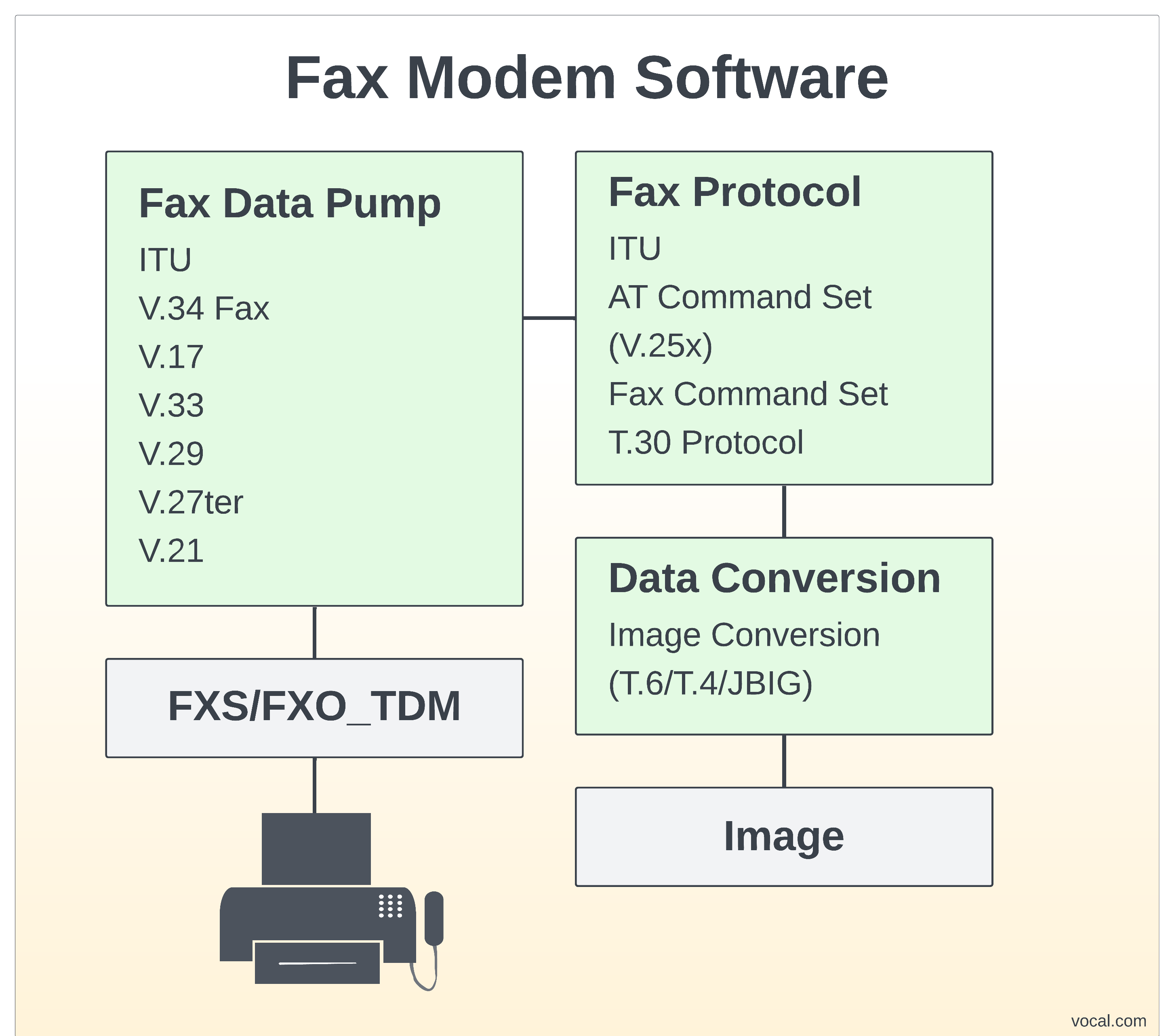
The V.21 channel 2 and V.27ter are the minimum requirements for Group 3 Fax. For non-V.34 fax, V.21 channel 2 is used to transfer T.30 control frames. The high speed facsimile modulations, V.27ter, V.29 and V.17, are used for compressed image transfer. The term compressed image refers to high speed data which may in actuality be other data, such as in the case of binary file transfer (BFT). As an option, these modulations can be combined with VOCAL’s V.34 fax to provide image transfer rates of up to 33,600 bps.

All of the facsimile modulations and data streams can be controlled with VOCAL’s T.30 functions or with VOCAL’s facsimile service class 1 command sets (EIA-578 and T.31). The T.30 functions could in turn be controlled with VOCAL’s facsimile service class 2 command sets such as T.32 (known as fax class 2.1), EIA-592 (known as fax class 2.0) and industry standard (known as fax class 2). Typical systems can be configured to use T.30 Error Correction Mode (ECM), T.4 copy quality checking/corrections and perform image form conversion for T.4/T.6 and JBIG.

The line interface may be an analog front end (codec and DAA) or a digital interface such as T1/E1, xDSL, ATM, and ISDN. The application interface of this software can support a fax class 2/2.0/2.1 command set or may be used directly by an application.

Call Progress

The system uses signal detectors to determine the progress of a call by audio means, obtaining user pressed DTMF digits and mode transitioning. The signal detectors and generators include:

  • Call Progress Tone
    • Both North American and International
    • Dialtone
    • Busy
    • Remote Ring (Ringback)
    • Congestion
    • Special-Information-Tone (SIT)
  • DTMF Detector
  • Programmable Precise Tone Detector
  • Fax/Data Modem
  • Fax CNG
  • Calling Tone (used by V.90, V.34, K56flex)
  • CED/Answer Tone (used by Fax, V.90, V.34, K56flex)
  • V.21 Ch 2 HDLC flags
  • Other Data Modems: V.32/V.32bis,V.22/V.22bis/Bell 212, V.21/Bell 103, V.23/Bell 202

Fax Modulations

Fax modulations available from VOCAL include:

  • V.34 fax - 2400 to 33,600 bps
  • V.17 - 7200, 9600, 12,000 and 14,400 bps
  • V.33 – 12000 and 14400 bps
  • V.29 - 7200 and 9600 bps
  • V.27ter - 2400 and 4800 bps
  • V.21 Channel 2 - 300 bps FSK

Fax Protocols

Fax protocols available from VOCAL include:

Fax Relay / Fax Over IP

Additional fax related software available from VOCAL include:

Fax Command Sets

System Monitoring and Diagnostics

The fax modem system software provides a wide variety of per-channel frame statistics and diagnostics, including V.59 diagnostic support, that are updated continuously during operation. The diagnostics and statistics are accessible by the driving application and can be used for system monitoring and network bandwidth management.  The types of data available from VOCAL’s diagnostics output include:

  • Modulation State
  • SNR MSE Measure
  • Tx/Rx Level dBm
  • Tx/Rx V.34 Symbol Rate
  • Round Trip Delay
  • Telemetry Data Update
  • Data Modulation Monitor Retrain/Renegotiate
  • Carrier Family
  • Disconnect Reason
  • Initial Tx/Rx Data Rate
  • Current Tx/Rx Data Rate
  • Data Protocol/Compression
  • V.PCM Digital Attenuation
  • V.PCM Robbed Bit Mask
  • V.PCM Coding Law
  • IETF Modem MIB support
  • V.59 Modem diagnostic support

Additional diagnostic signaling can be selected by the driving application to aid in integration and system troubleshooting.

Features

Facsimile features are available on a per channel basis for the following:

  • T.37 Store and Forward Fax
  • T.38 Real-Time Fax Relay/Fax over IP
  • V.21 Channel 2 at 300 bps
  • V.27ter at 2400 and 4800 bps
  • V.29 at 4800, 7200 and 9600 bps
  • V.17 at 7200, 9600, 12000 and 14400 bps
  • V.33 at 12000 and 14400 bps
  • T.30 Facsimile Protocol
  • T.30 Error Correction Mode
  • T.4: 1d, 2d, MMR, Format Conversion Copy Quality Checking
  • Diagnostic support for modem MIB

Platforms

VOCAL’s Fax Modulation and Protocol software is available for the following Platforms:

  • Texas Instruments – TMS320 C5000 and C6000 families, DaVinci, OMAP
  • Analog Devices – Blackfin, ADSP-21xx, TigerSHARC, SHARC
  • AMCC – PowerPC
  • MIPS – MIPS32, MIPS64, MIPS4Kc
  • ARM – ARM7, ARM9, ARM9E, ARM10E, ARM11, StrongARM
  • iPhone / iPad
  • Android
  • Atmel
  • CEVA – Teak, TeakLite, Palm, Oak
  • Microchip dsPIC
  • AMD x86 (MMX) – AMD Geode SC1200
  • Intel
  • PowerQUICC – PowerQUICC Pro (83xx), PowerQUICC III (85xx) families
  • Ikanos – Fusiv processors
  • ARC Processor IP
  • NXP Philips Trimedia – TM1000, TM1100, TM1300
  • VeriSilicon (LSI Logic) ZSP

Please contact us for other supported platforms.

Operating Systems

VOCAL’s Fax Modulation and Protocol software is available for the following Operating Systems:

  • Android
  • iOS
  • Unix,  Linux, uClinux
  • Microsoft Windows ACM / RTC / CE / Mobile
  • Symbian,
  • Mac OS
  • BSD
  • VxWorks
  • Integrity

Please contact us for other supported Operating Systems.

Social Media

Contact Us

VOCAL Technologies, Ltd.
520 Lee Entrance, Suite 202
Amherst, New York 14228
Phone: +1-716-688-4675
Fax: +1-716-639-0713