
VOCAL’s Remote Radio Monitoring system provides interception and monitoring of low power radio transmissions over dial-up or public/private Internet Protocol networks. Interception of low-power radio transmissions often requires field deployed devices in locations which are barely equipped with power and telephone lines and rarely with real Internet connections. Remote monitoring facilities may be considered as a general resource of a parent enforcement agency to be assigned to other organizations on a situational basis. Such sharing of resources can be further improved by the use of today’s technology. Contact us to discuss your radio monitoring application requirements.
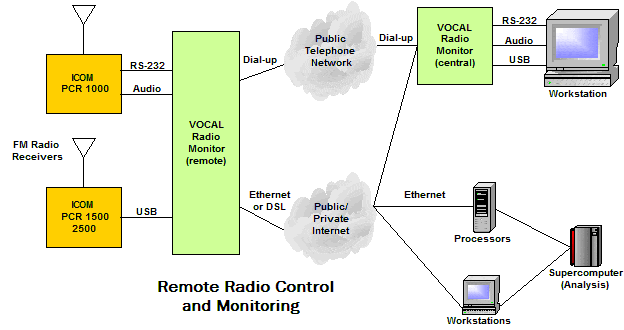
VOCAL’s Remote Radio Monitor supports dial-up access of field deployed radio receivers. Wideband receivers, such as the ICOM PCR1500/2500 devices, are ideal candidates for monitoring applications. Serial or USB communications with the actual radio is carried in a Telnet-style connection from a central monitoring location to the field deployed radio. Audio is digitized, compressed and packetized using Internet standards for VoIP and Radio over IP. In this case SIP and RTP are used to initiate audio connections as well as for its delivery. Special radio tones (SELTONE, CTSS, etc) can be detected remotely and delivered as out-of-band indications within the RTP stream.
VOCAL’s Remote Radio Monitor supports distribution of received radio traffic to multiple destinations. In an enhanced radio monitoring system, multiple listening posts may receive the radio audio from each location being monitored. In such a system, a radio monitor server communicates with all remotely located radios and distributes the audio to each listening station. This configuration may use the dial-up networking connection or a public/private Internet connection (supported by the VOCAL Radio Monitor Ethernet). The figure below illustrates some of the deployments possible with the VOCAL radio monitoring system.