
TR-069 Reference Design implements the Broadband Forum’s TR-069 Management Protocol for remote configuration and provisioning of client Customer Premises Equipment (CPE) . Our TR-069 software stack supports automatic provisioning of VoIP and Gateway Devices via a TR-069 Auto-Configuration Server (ACS). Custom solutions are available to meet your specific requirements.

VOCAL’s TR-069 reference design software is optimized for leading DSP and conventional architectures from TI, ADI, Intel, ARM and other vendors. Our extensive custom design and development experience in the telecommunication industry will help speed your product development effort. Contact us to discuss your TR-069 protocol application.
TR-069 Software
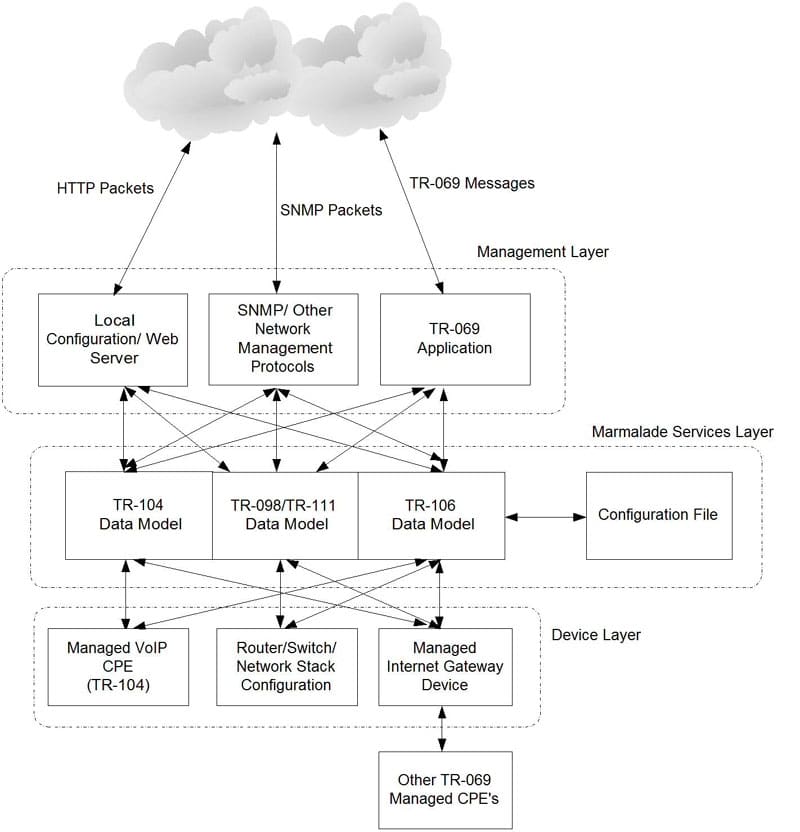
VOCAL’s TR-069 software provides three main layers – management layer, marmalade services, and the VoIP application. The management layer consists of three components – the TR-069 Management Protocol client application along with SNMP and other network management protocols. In addition local configuration commands and a web server provide for on-premises configuration of the CPE device. The main responsibilities of the TR-069 software management layer are:
- Establishing an HTTP connection to the ACS
- Parsing and generation SOAP/XML messages
- Executing the Remote Procedure Calls (RPC) to the CPE
The TR-069 software marmalade services layer provides the glue between Broadband Forum’s data models and the VoIP application. It provides notifications, alerts and synchronization locks for data integrity. The configuration file allows for permanent storage of changes to the data models. The changes to the data models of the marmalade service layer are implemented in the software of the managed devices on the device layer.
The changes to the data models of the marmalade service layer are implemented in the software of the managed devices on the device layer. Some of our major features include:
- Video conferencing
- SIP support with multiple provides
- Encrypted communication using secure RTP (SRTP)
- Network stack with NAT/firewall support
- Voice codes such as G.711, G.722, G.726, G.729AB, and MELP
- Line (G.168) and Acoustic Echo Cancellation
- An extensive set of telephony features
- Call Progress tones with world-wide configurability
- Ring patterns with multiple ringing tones
- Reference hardware design support
Our optimized software allows all DSP functions and application and management protocols to be processed on a single processor. This provides a cost effective product solution with a quick time to market.
TR-069 Management Protocol
TR-069, officially referred to as the CPE WAN Management Protocol (CWMP), is used for establishing communication between the client CPE and the remote ACS. A customer’s device (e.g. VoIP phone) can have its operational features remotely modified by an ACS, such as which voice codecs may be used during a call, which VoIP service provider to use, etc.
TR-106 is the baseline data model for the TR-069 Management Protocol. This data model includes the basic device information such as: the Manufacturer of the device, hardware and software version of the device. The data model also includes the basic Management Server information such as: the URL of the ACS, and the username and password for the CPE.
TR-098 and TR-111 provide the data models for Internet Gateway devices within the TR-69 management protocol. The TR-098 data model describes the Gateway device itself. The TR-111 data model is designed to inform the ACS the number of the manageable devices connected to the gateway, and their corresponding manufacturer and serial numbers and product class.
TR-104 is the data model that handles management of the VoIP device. This data model informs the ACS the capabilities of the VoIP device. In addition to configurable parameters such as: which codecs to use, ring patterns, etc.
TR-069 Client Interoperability
VOCAL’s TR-069 Client is fully compliant with the TR-069 management protocol for use with ACS from different vendors. Our TR-069 Client software automatically discovers the ACS periodically, at startup, or when notified by the ACS. The TR-069 Client uses a secure network connection to reconfigure CPE device settings and controls, activates vendor services, and updates applications as provided by the ACS.
VOCAL’s TR-069 client software has recently completed extensive interoperability testing with the Tilgin ACS. The TR-069 Client and ACS Server provide full life-cycle support of CPE devices including initial activation, service upgrade, maintenance and subscriber care. Our TR-069 Client and the ACS server automatically coordinate delivery of all services and device updates without any customer intervention.
More Information
Platforms

VOCAL’s optimized software is available for the following platforms. Please contact us for specific TR-069 supported platforms.
| Processors | Operating Systems |
|---|---|
|
|