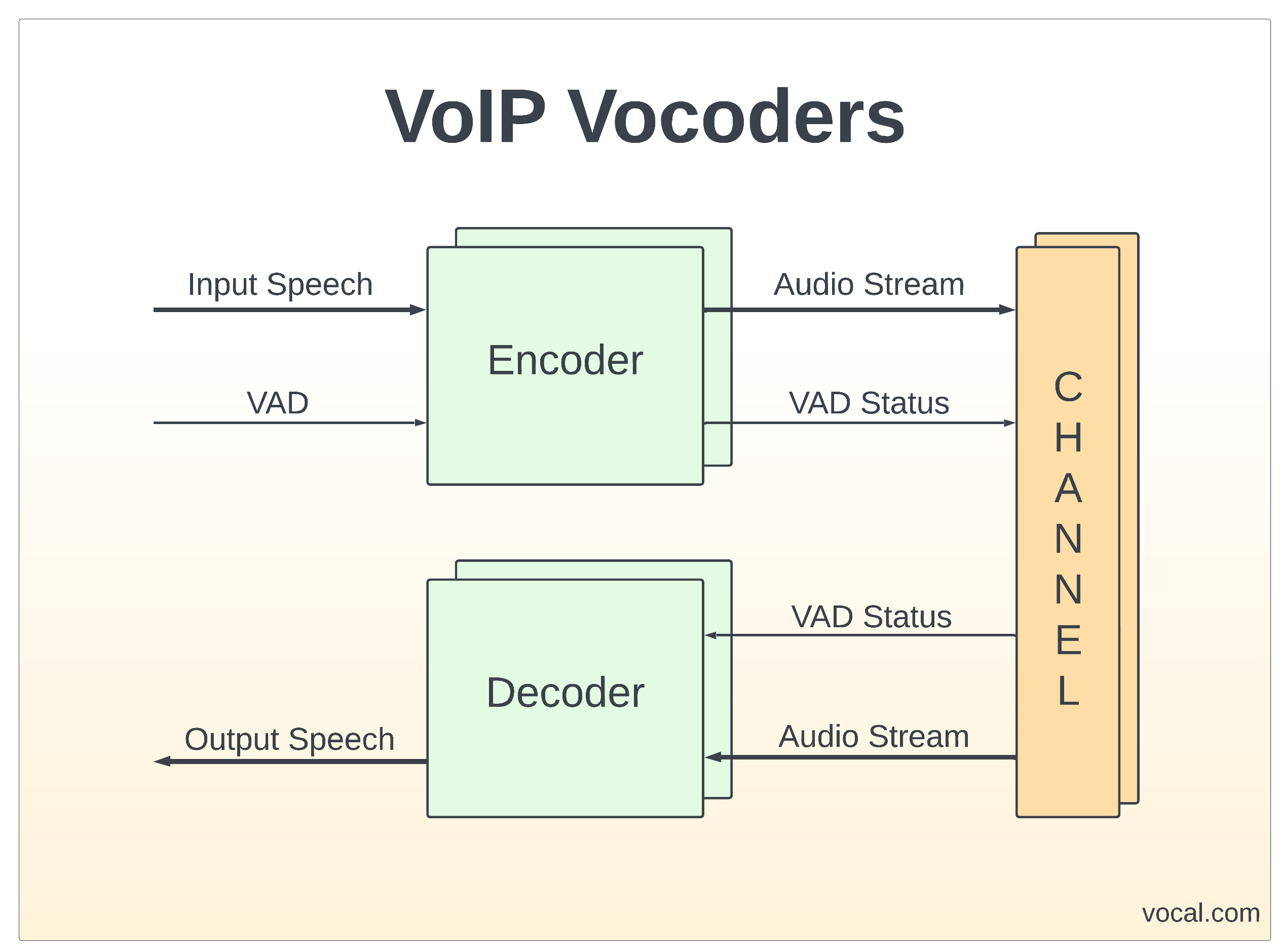
VOCAL’s Speech Coder Software includes a complete range of speech compression algorithms optimized for execution on ANSI C and leading DSP architectures (TI, ADI, AMD, ARM, MIPS, CEVA, LSI Logic ZSP, etc.). Native software libraries are also available for Android, iOS, and other mobile VoIP applications. VOCAL’s vocoder software modules may be licensed by developers either standalone or as a library. Custom solutions are also available to meet your unique application requirements.

Each speech coder may or may not be appropriate for a function and/or platform. Reference MIPS/memory requirements as well as PSQM/PSQM+ values for different voice coders under various network conditions are available from VOCAL for comparison. When evaluating a particular voice codec, please Contact Us to discuss your digital signal processing algorithm requirements.
Applications
- Mobile VoIP
- Audio and video conferencing
- VoIP services
- WIFI phones VoWLAN
- Wireless GPRS EDGE systems
- Wideband IP telephony
- Transcoding/transcode between vocoders
- Fax over IP/Fax Relay
- Enhanced Voice Services (EVS) Codec
- Immersive Voice and Audio Services (IVAS) Codec
Features
- Full and half duplex modes of operation
- Pass ITU test vectors
- Compliant with ITU specifications
- Optimized for high performance on leading edge DSP architectures
- Multichannel implementation
- Multi-tasking environment compatible
- Variable speed playback
Speech Coder Modules
VOCAL’s speech compression digital signal processing algorithms are available in C and optimized assembly code for the following speech coder modules:
- Voice Over Network Framework – RTP Packetization, AAL2 Framing
- ITU Speech Coders (Audio Examples) fully comply with ITU standards
- G.711 – 64k bps PCM (A-law or μ-law form)
- G.719 – Fullband Audio Coding
- G.722 – 7 kHz audio coding within 64 kbit/s (SB-ADPCM)
- G.722.1 – 24k and 32k bps, 7 kHz audio
- G.722.2 – Adaptive Multi-Rate Wideband (GSM AMR-WB)
- G.723.1 – 5 1/3k and 6.4k bps ACELP/MP-MLQ
- G.726 – 16k, 24k, 32k and 40k bps ADPCM
- G.727 – 5, 4, 3 and 2-bits sample Embedded ADPCM
- G.728 – 16k bps LD-CELP
- G.729/G.729A – 8k bps CS-ACELP
- G.729 Annex B – Silence Detection
- G.729D – 6.4k bps CS-ACELP
- G.729.1 – Embedded Variable Bit-Rate
- 3GPP Speech Coders (Audio Examples) fully comply with ETSI standards
- GSM-FR – GSM 06.10 Full Rate Vocoder
- GSM-HR – GSM 06.20 Half Rate Vocoder
- GSM-EFR – GSM 06.60 Enhanced Full Rate Vocoder
- GSM-AMR – GSM 06.90 Adaptive Multi-Rate Vocoder
- GSM-AMR-WB – 3GPP TS 26.171 Adaptive Multi-Rate Wideband (ITU G.722.2)
- EVS – 3GPP TS 26.442 Enhanced Voice Services Codec
- IVAS – 3GPP Immersive Voice and Audio Services Codec
- Wideband Speech Coders (Audio Examples) with support for HD audio
- Other Speech Coders (Audio Examples) developed for government organizations and private industry
- iLBC – Internet Low Bitrate Codec
- LPC-10 – LPC-10
- MELP – Mixed-Excitation Linear Predictive
- MELPe – Mixed-Excitation Linear Predictive Enhanced
- TSVCIS – Tactical Secure Voice Cryptographic Interoperability Specification
- Speex – 8 kHz, 16 kHz, and 32 kHz CELP
- SILK – Variable Bitrate Wideband Speech Codec
- Opus – Interactive Audio Codec
- Voice Activity Detection (VAD)
- Packet Loss Concealment (PLC)
- Adaptive Jitter
- Voice/Facsimile/Data Modem Detection
- Enhanced Voice Services (EVS) Codec
Configurations
- DAA interface using linear codec at 8.0 kHz sample rate
- Direct interface to 8.0 kHz PCM data stream (A-law or μ-law)
- North American/International Telephony (including caller ID) support available
- Simultaneous DTMF detector operation available – (less than 10 talkoff hits on Bellcore test tape set)
- MF tone detectors, general purpose programmable tone detectors/generators available
- Data/Facsimile/Voice Distinction available
- Common speech compression frame stream interface to support systems with multiple speech coders
- Dynamic speech coder selection if multiple speech codecs available
- Can be integrated with G.168 Echo Canceller and Tone Detection/Regeneration modules
- Complete facsimile systems available – modulations (V.34fax, V.17, et al.) and protocols (T.30) as a facsimile terminal or facsimile relay configuration
- Complete data modem systems available – modulations (V.90, V.34, et al.) and protocols (V.42, PPP framing, et al.)
- Various startup procedures available (V.8 and V.8bis)
- Multiple ports can be executed on a single DSP

VOCAL’s solution is available for the above platforms. Ask about our RUST programming language implementations. Please contact us for specific supported platforms.