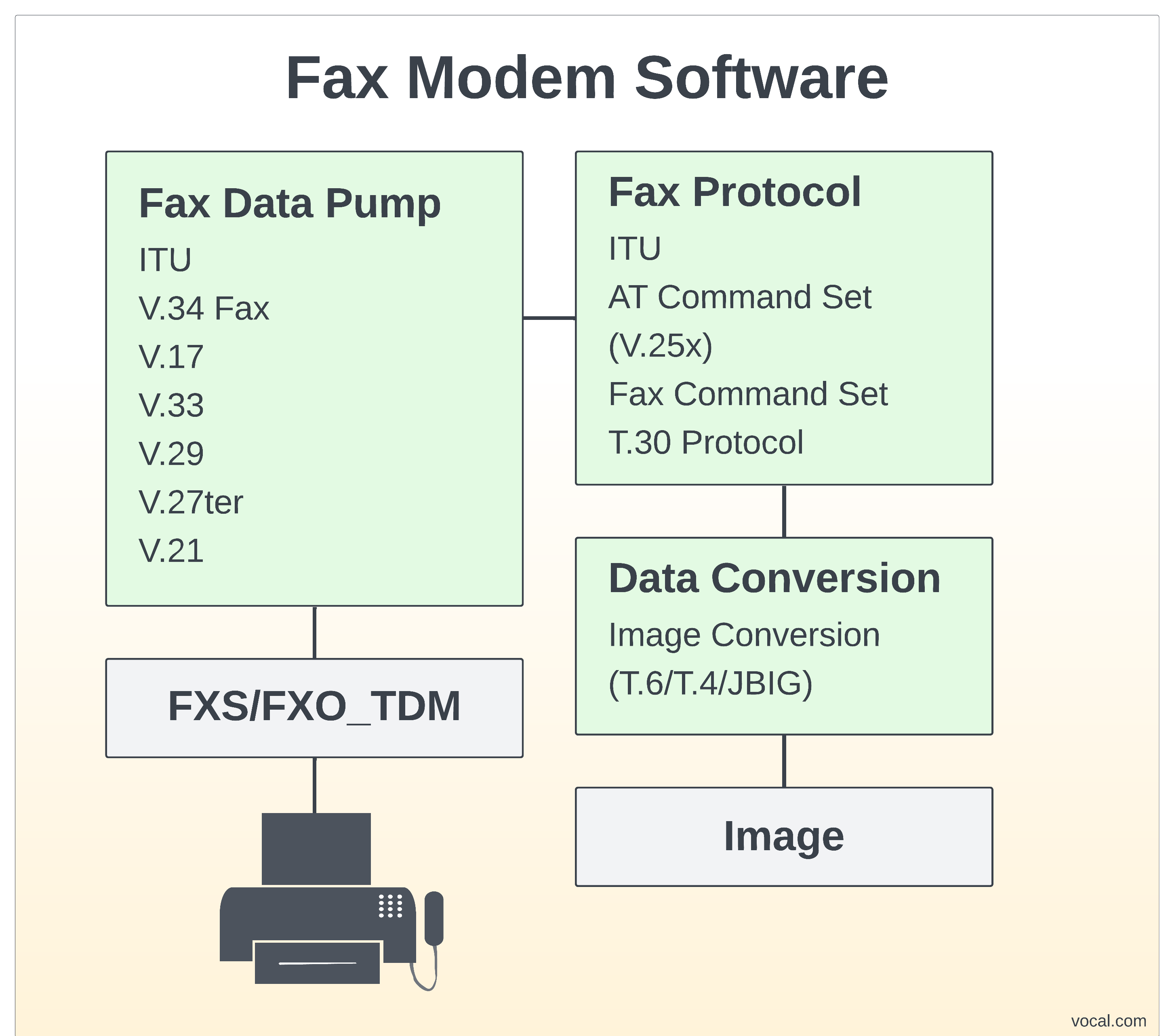
T.30-E Color Fax software allows users to send and receive color facsimiles per the ITU T.30-E Color Fax standard. The T.30 protocol itself provides software developers complete Group 3 facsimile control. The T.30-E color fax libraries are modular and can be configured to support multichannel applications. The software can be executed as a single task under a variety of operating systems or standalone with its own microkernel. Contact us to discuss your fax software application requirements.

VOCAL’s T.30-E color fax software is optimized for DSPs and RISC/CISC processors from ADI, ARM, TI, Intel and other vendors. It is available standalone, as an embedded library, or with a VoIP stack. Custom designs are available to meet specific developer requirements.
T.30-E Color Fax Protocol
T.30-E color fax protocol uses an encoding methodology for continuous-tone (multilevel) color images based on the lossy mode of encoding based on the Discrete Cosine Transform (DCT) of JPEG (T.81) image encoding standard. T.30-E uses Forward Error Correction defined in T.42 and adopts a device-independent color space representation, the CIELAB space, which allows unambiguous exchange of color information.
Recommendation T.30-E also indicates the procedure for negotiation of the capabilities for transmission of continuous-tone color and gray-scale images. T.30-E fax protocol specifies the definitions and the specifications of new entries to the Facsimile Information Field of the DIS/DTC and DCS frames of Recommendation T.30. The information includes image digitization resolution (in bits/pel), spatial resolution, sampling ratio of color components, JPEG capability, color capability, and image data scaling that is subject to negotiation in the pre-message phase of the T.30 protocol.
The technical features of T.30-E color fax encoding and decoding the continuous-tone color and gray-scale image data are described in Annex E/T.4. It describes two modes of image encoding (lossy gray-scale and lossy color) which are defined using Recommendation T.81.
Features
- Supports control of facsimile high speed modulations up to V.34 Fax 33,600 bps.
- T.30 session control and negotiation
- Supports facsimile polling operation
- Supports procedure interrupts
- Optional Error Correction Mode (ECM) available
- Optional Binary File Transfer (BFT) available
- T.4 1-dimensional Image Decoding/Reencoding
- T.4 2-dimensional/ T.6 Image Decoding/Reencoding available
- In-band data format conversion support available
- Multi-tasking environment compatible
Configurations
- Configurable for standalone operation (no command set layer required).
- Facsimile Relay / Facsimile-Over-IP(T.Ifax2) configurations available
- Error Correction Mode memory can be maintained off-system. (Recent modifications to the T.30 specification have reduced the ECM memory size requirement from 64k bytes to 16k bytes, however 64k bytes is still recommended for backward compatibility.)
- Facsimile service class 2 command sets such as T.32 “class 2.1”, EIA-592 “class 2.0” and industry standard “class 2” are available.
- Multiple protocol ports can be executed on a single DSP.
- VOCAL’s Overall Modem Controller (OMC) Layer provides coordinated data modem/ facsimile operation relative to dialing procedures, Data/Facsimile/Voice Distinction upon startup.
- Supports overlayment of data and facsimile protocol memory space where applicable.

VOCAL’s solution is available for the above platforms. Please contact us for specific supported platforms.