VOCAL offers T.38 Fax over IP software that may be licensed by developers or especially part of a complete design. T.38 Fax over IP enables transmission of proprietary and industry standard real time Group 3 and high speed V.34 fax using fax over IP (FoIP) networks. Our fax relay solutions support SIP, T.30 and T.38 protocol for seamless and transparent fax transfers between internet aware fax devices, T.38 gateways, and fax servers. The API is designed to simplify control of T.38 fax over IP sessions with fax gateways and other FoIP equipment.

Request a brochure or contact us to learn how VOCAL can accommodate your T.38 FoIP application requirements.
Supported Modulations
- V.34 fax data channel – full and half duplex modulation for data rates from 2400 bps to 33600 bps.
- V.34 fax control channel – 1200/2400 bps modulation for use with half duplex procedures
- V.17 – 7200, 9600, 12,000 and 14,400 bps trellis coded modulation
- V.29 – 7200 and 9600 bps modulation
- V.27ter – 2400 and 4800 bps modulation
- V.21 Channel 2 – 300 bps modulation
T.38 Fax Software Features
- Fully integrated Group 3 Facsimile processing system
- Configurable for both TCP/IP and UDP/IP modes of data transmission
- Configurable type/amount of redundant information for UDP/IP service
- Configurable for UDPTL forward error correction messages
- Configurable high speed training mechanism – Local TCF generation or TCF transmitted between end-terminals
- Optimized for high performance on leading edge DSP architectures
- Multichannel implementation
- Multi-tasking environment compatible
- Error Correction Mode
- Fax and voice software compatibility
- Fax detection for detecting voice call vs fax call on a single line.
- Fax statistics
T.38 Protocol and Real-Time Super/Group 3 Facsimile
T.38 protocol enabled devices allow the use of ordinary Super/Group 3 facsimile as well as high speed V.34 fax machines on IP networks, permitting ATAs or other FoIP products to relay calls through a VoIP service. Without T.38 fax protocol, successful calls can be placed, but these can be less reliable than facsimile transmissions through an ordinary telephone line. With T.38 protocol, the user should not even know that a VoIP service is being used instead of a land line connection.
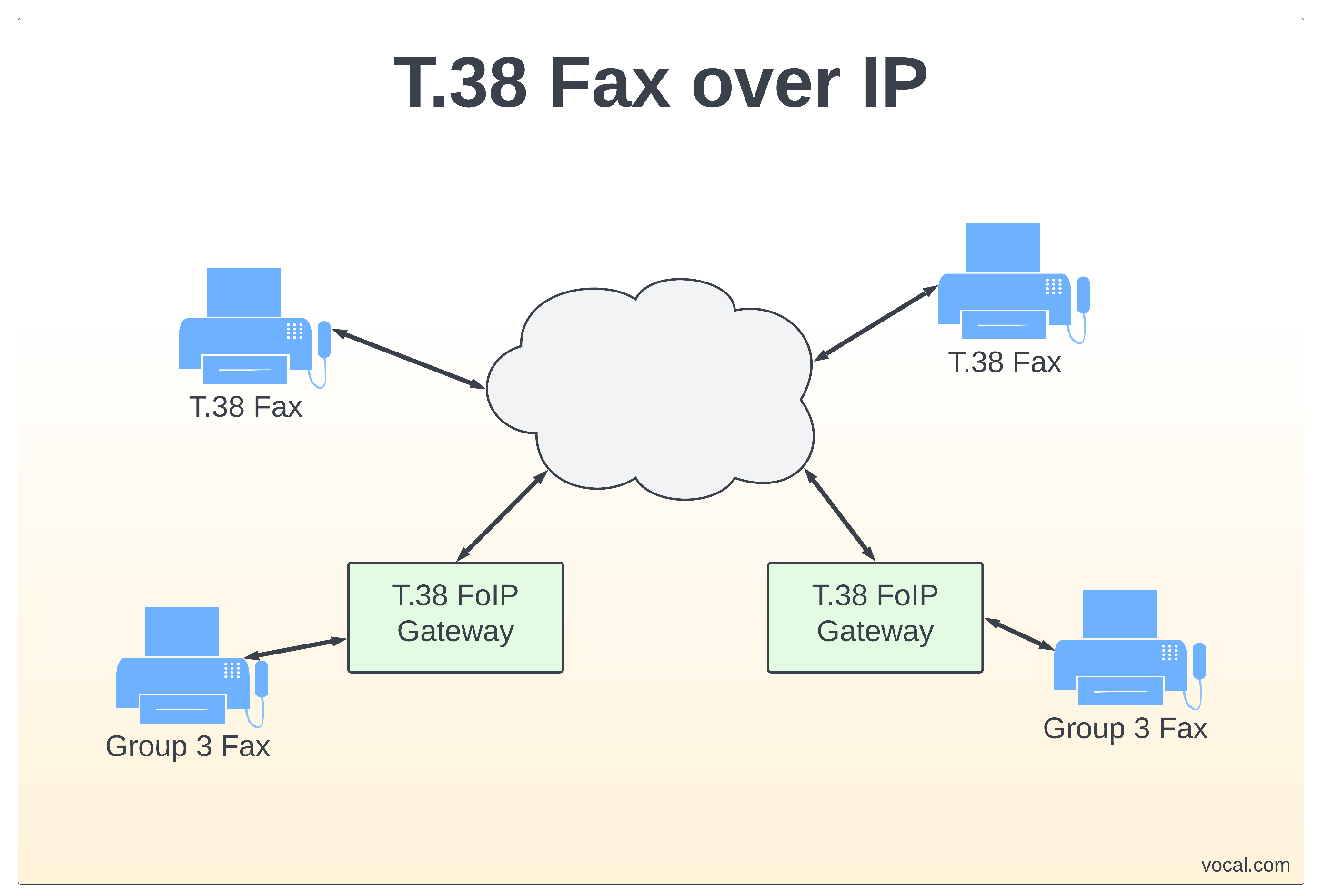
T.38 fax relay is used when a Group 3 fax device sends a fax over PSTN to a T.38 FoIP gateway. The gateway converts or encapsulates the T.30 protocol into a T.38 data stream sent either to a T.38 enabled end point such as an internet aware fax machine or fax server or to another T.38 fax gateway where the data stream is converted and transmitted to a T.30 device. Internet aware fax equipment can transmit and receive faxes directly using T.38 fax relay without an intervening FoIP gateway.
T.38 Fax over IP with SIP
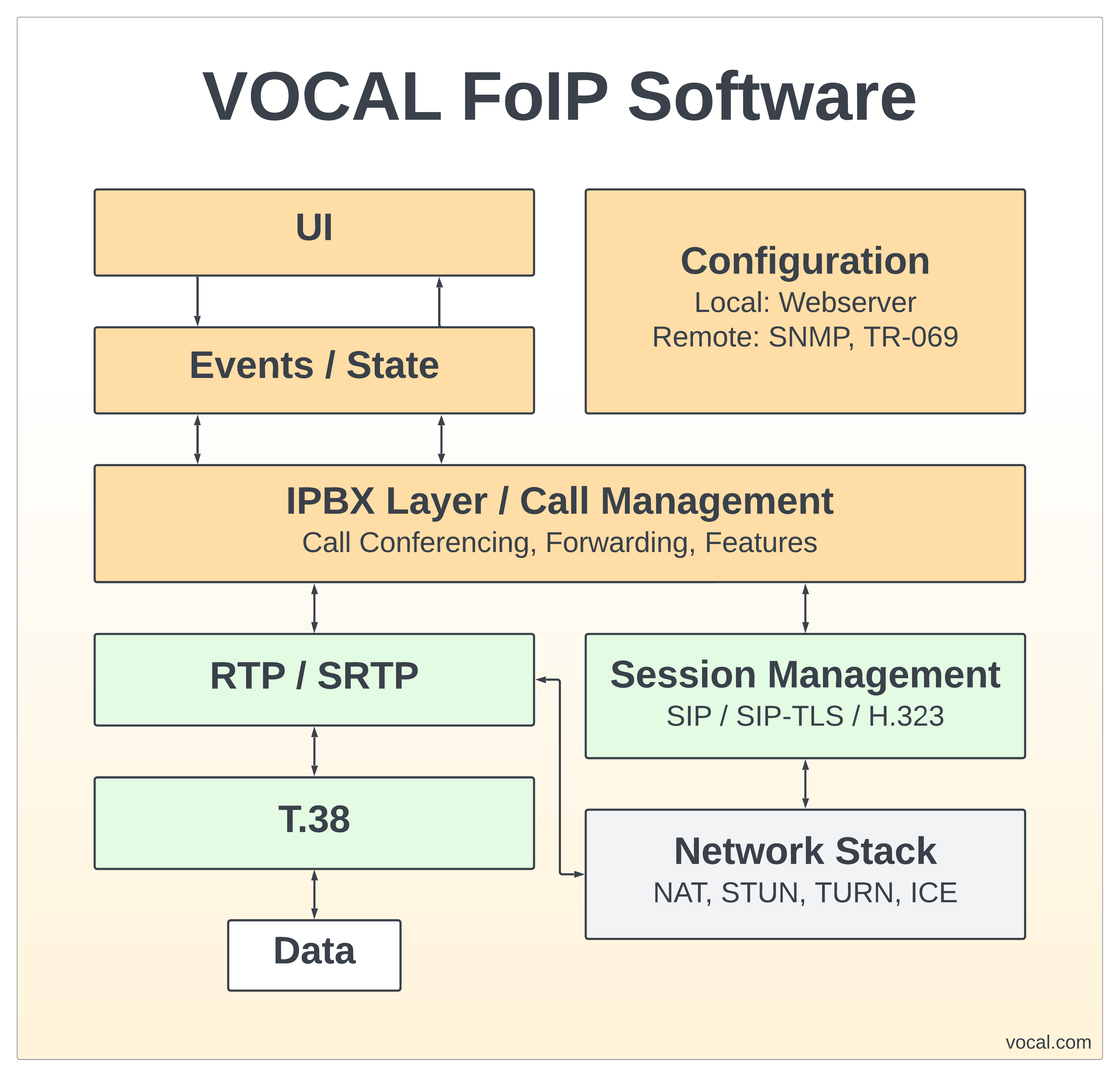 T.38 Fax over IP can be combined with VOCAL’s SIP and network stacks to obtain seamless voice and/or fax relay operation from call startup to disconnect. Complete facsimile server call control is also available and can be combined with our real-time Group 3 fax store and forward module.
Alternatively, when integrated with VOCAL’s SIP and T.30 protocol modules and TCP/IP network stack, a standalone internet-ready T.38 protocol capable facsimile end terminal can be realized. In this configuration the modulation layer is unnecessary and so interoperability with high speed V.34 fax based terminals can be achieved without the need of digital signal processing.
VOCAL’s T.38 Fax over IP modules are available for use with either the VOCAL or other vendor-provided FAX pumps. The interface points are at the sample layer for the VOCAL pump or the Class 1 command set for other vendor-provided pump layers. The network interface is either RTP or UDPTL. The protocol negotiation and setup is initiated by other modules, either from VOCAL or vendor provided. A block diagram illustrating the relationship between these T.38 fax software modules is available.
In a typical network environment where SIP is used to establish sessions between two (or more) entities, the T.38 fax call flow is normally indicated by SDP entries in the initial SIP INVITE message. This may be through a particular codec type in the audio stream or through an independent media stream different from the voice audio media stream.
After the initial INVITE, the session is typically established as an ordinary audio voice call, with the ability to switch to fax relay mode. With dedicated facsimile machines the initial INVITE may actually set up a T.38 connection first, which can be easily handled by modifying the startup sequence to skip the autodetection phases. At this point, either the detection of a tone in the local audio codec stream or the receipt of a network event such as a SIP RE-INVITE or the receipt of a RTP packet will force a transition to the fax relay mode.
Configurations
- SIP based system available for industry standard and proprietary Fax over IP networks
- Facsimile/Voice Distinction available for seamless facsimile/voice system operation
- Direct interface to 8.0 kHz PCM data stream (A-law or μ-law), run-time time-slot selection
- Analog DAA interface using linear codec at 8.0 kHz sample rate
- North American/International Telephony supports DTMF generation, dialing procedures, call progress, Caller ID, etc.
- Group 3 Facsimile store-and-forward features available
- Group 3 Facsimile End Terminal operation with direct T.38 protocol interface available
- Complete VoIP systems available (speech codecs, DTMF tokens, silence tokens, etc.)
- Speech codecs include V.34 fax, G.711, G.723, G.729, G.729A, GSM, G.728, G.726/G.721
- Complete data modem systems available (through V.90/V.42bis and V.34fax/T.30)
- Multiple ports can be executed on a single DSP
VOCAL’s T.38 fax source code is optimized for performance on ANSI C and leading DSP architectures from TI, ADI, ARM, Intel and other vendors. Our T.38 fax software may be licensed by developers as a library or especially part of a complete design. Custom solutions are also available. Contact us to discuss your specific T.38 fax protocol application requirements.
Additional T.38 Information
- T.38 Transmission Over SRTP
- T.38 Prioritization in a Universal Gateway
- Comparison of T.38 and V.152
- Modifications to T.38 Standard
- T.38 Block Diagram
- ITU Recommendation

VOCAL’s solution is available for the above platforms. Please contact us for specific supported platforms.