VoCAL Print Logo
Data Modem >  Modulations

Data Modulations

Data Modulations
V.92
V.90
56K
V.34
V.32bis/V.32
V.22bis/V.22
V.23/V.21/Bell 212/Bell 103

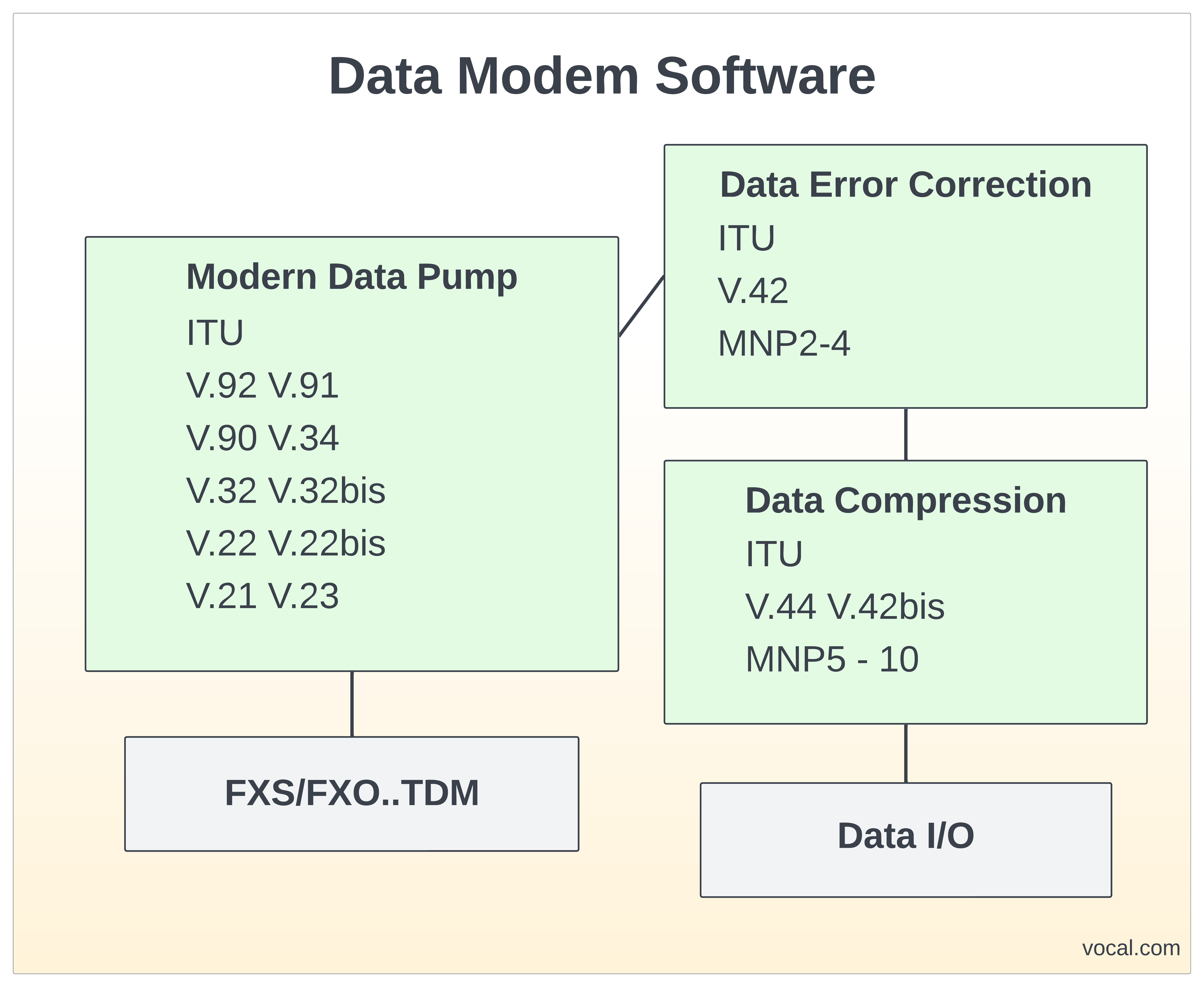
VOCAL offers a comprehensive and fully optimized data modem solution for a wide variety of platforms. A modulation family can be combined with other data modulations (V.92, V.90, V.34, V.32bis/V.32, and V.22bis/ V.22/V.23/V.21). Automatic modulation determination procedures (Automode) include those of V.8, V.8bis and PN-2330. All data modulation software is fully compatible with VOCAL's facsimile, telephony, speech coder and multimedia systems.

The line interface may be an analog front end (codec and DAA) or a digital interface such as T1/E1, Switched 56, and ISDN. The upper end of this software can provide a PPP, HDLC, V.14 or a direct binary framing layer. Higher data protocol layers, V.42 (including MNP 2-4), V.44, V.42bis and MNP 5, are options as well.

VOCAL's embedded software libraries include a complete range of ETSI / ITU / IEEE compliant algorithms, in addition to many other standard and proprietary algorithms. Our software is optimized for execution on ANSI C and leading DSP architectures (TI, ADI, AMD, ARM, MIPS, CEVA, LSI Logic ZSP, etc.). These libraries are modular and can be executed as a single task under a variety of operating systems or standalone with its own microkernel.


V.92 Modem

V.92 is an ITU dial-up modem standard that provides for an increase in upload speeds (PCM upstream or PCMU), quicker connect times (Quick Connect or QC), and a Modem-On-Hold (MOH) feature that allows the modem to work in conjunction with call waiting provided by the phone company.

V.92 Upstream

V.92 specification allows a PCM upstream at rate from 24,000bps to 48,000bps. The rate increments in steps of 1.33 kbps as in V.90. Upstream rates could be 24k, 25.3k, 26.6k, 28k, etc. This is a 30% increase over the 33.6K bps attainable by V.90 modems. This higher upstream speed offers numerous benefits including a reduction in the upstream data transfer time for large e-mails with attachments and for ftp site uploads, as well as improved operation for interactive applications. Due to the real conditions of the phone lines the 48 kbps upstream is very hard to obtain.

Modem On Hold

Allows modems to stay connected "on-hold" while you take an incoming call waiting call, or initiate an outgoing voice call (works only if V.92 server modem is configured to allow this feature). The amount of time you can place your Internet connection on hold while taking another call will be up to your Internet Service Provider (ISP).The V.92 recommendation permits ISPs to set their modems to wait for 0 to 16 minutes, or, to wait indefinitely. V.92 client modems may include software that will warn the user when the ISP determined timeout approaches, as well as to display call waiting caller ID info (requires telco call waiting/caller ID service). ISPs have an incentive to limit the use of this feature: when a call is placed on hold, the ISP modem remains unavailable to take other calls. The ISP may need to add more modems to maintain quality of service if this feature is enabled. The ISPs also have the posibility of do not accept modem-on-hold if the total time of modem-on-hold in the same session is greater that a determined value.

Quick Connect

In the ITU V.92 recommendation the time to establish a connection may be reduced with faster handshaking, using a short phase 1 and phase 2, reducing the connection time to about 20 seconds. It is also possible to reduce more this connedction time to around 10 seconds using short phase 3 and phase 4 (this feature is not in the ITU V.92 recommendatin) by forcing V.92 modems to remember line conditions and connect rates on past connections by storing data about those connections in a buffer. The modem will compare line quality variables as it dials in to a server modem with those in the buffer, and if a match is found, the handshake starts at the rate previously negotiated. Quick Connect will also be used with Modem On Hold: when a call is switched back to the modem after using the MOH feature, a retrain is required. When the V92 modem uses short phase 3 and phase 4 and the line conditions are different, the V.92 modem have to fall-back to a full retrain.

V.92 Datasheet


V.91/V.90 Modem

Depending upon V.90 configuration selected, the line interface may be an analog front end (codec and DAA) or a digital interface such as T1/E1, switched 56 and ISDN. The upper end of this software can provide PPP, V.14, HDLC or direct binary framing layers. Higher data protocol layers, V.42 (including MNP 2-4), V.44, V.42bis and MNP 5 are options as well.

Terminology

  • V.90 (Determined February 1998) refers to procedures between a "digital modem" and an "analog modem". The analog modem, which may be connected to the PSTN through either an analog or digital interface, transmits V.34 signals and receives G.711 PCM signals. The digital modem, which is connected to the PSTN through a digital interface, transmits G.711 PCM signals and receives V.34 signals.
  • V.90 (Determined February 1998) refers to analog/digital configurations. Future ITU recommendations or extensions to V.90) may refer to digital/digital configurations and/or PCM transmit and receive for an analog/digital configuration.

Features

  • Compliant with draft V.90, upgrades as recommendation is approved.
  • Modem MIB Support (RFC 1696).
  • Specifies 22 modulation rates in range of 28000 bps to 56000 bps, in increments of 1 1/3 kbps. (Administration requirements may restrict maximum rates/power allowed).
  • Multi-tasking environment compatible.

Configuration

  • As per terminology above, three V.90 system configurations are relevant: systems that implement an analog modem only, systems that implement a digital modem only, and systems in which the modem can take on the role of either an analog or digital modem.
  • Analog modem DAA interface using linear codec at 16.0 kHz sample rate.
  • Digital modem direct interface to 8.0 kHz PCM data stream (A-law or μ-law).
  • PPP (RFC1662), V.14, HDLC and direct binary framing layers available.
  • North American and International Dialing/Telephony functions available.
  • Data protocol layer (V.42/MNP2-4/V.44/V.42bis/MNP 5) available.
  • System can be combined with V.110 rate adaptation software.
  • System can be combined with other modulations (V.92, V.34, V.32bis, et al.) and automode procedures(V.8bis, V.8 and PN-2330).
  • Data/Facsimile/Voice Distinction upon startup available. Complete facsimile systems, modulations (V.34, V.17 et al.) and protocols (T.30), and speech coders available.

Figure 1 shows VOCAL's V.90 block diagram.


Figure 1 V.90 Block Diagram


V.34 Modem

ITU-T V.34 defines the modulation methods and operating sequences for a modem used on General Switched Telephone Networks (GSTNs) and on point-to-point 2-wire leased telephone-type circuits. Both full duplex and half-duplex modes are supported. Data rates in the range of 2400 bps to 33600 bps, in incremental steps of 2400 bps are supported. Symbol rates of 2400, 2743, 2800, 3000, 3200, and 3429 symbols per second are supported. Using Quadrature Amplitude Modulation (QAM) with synchronous line transmission, selectable mandatory rates are 2400, 3000, and 3200 symbols/s with optional rates of 2743, 2800 and 3429 symbols/s. Asymmetric symbol and data rates are also supported. Negotiation and training sequences at startup establish the data rate. Control channel rates are 1200 and 2400 bps, with an optional auxiliary channel with a synchronous data signalling rate of 200 bit/s.

Trellis coding for all data signaling rates and shell mapping permit satisfactory performance even over noisy channels. Adaptive techniques enable the modem to achieve close to the maximum data signalling rate a channel can support on each connection. VOCAL's V.34 software uses state-of-the-art line probing analysis to automatically determine maximum channel capacity. It also support MSE fallback/fallforward threshold control to adjust the tradeoff between higher data channel rates and symbol error rates. Channel separation is accomplished using echo cancellation techniques.

Features

  • Fully compliant with ITU recommendations
  • Supports 14 data rates in the range of 2400 bps and 33600 bps (increments of 2400 bps)
  • Modem MIB support (RFC 1696)
  • Optimized for high performance on leading edge DSP architectures
  • Multi-tasking environment compatible
  • Symbols rates for 2400, 2743, 2800, 3000, 3200, and 3429 symbols per second
  • 200 bps auxiliary channel
  • Asymmetric symbol and data rates
  • State-of-the-art line probing analysis to automatically determine maximum channel capacity
  • MSE fallback/fallforward threshold control to adjust tradeoff between higher data channel rates and symbol error rates

Configuration

  • DAA interface using linear codec at 9.6 kHz, 8.0 kHz, or 16.0 kHz sample rate
  • Direct interface to 8.0 kHz PCM data stream (A-law or μ-law)
  • PPP (RFC 1662), HDLC, V.14 and direct binary framing layer
  • North American and International Dialing/Telephony dialing functions available
  • Data protocol layer (V.42/MNP 2-4/V.44/V.42bis/MNP 5) available
  • VOCAL's Overall Modem Controller (OMC) Layer provides coordinated data modulation/data protocol operation relative to startup, shutdown, modulation retrains and modulation renegotiations.
  • System can be combined with V.110 rate adaptation software.
  • System can be combined with other modulations (V.92, V.90, V.32bis, et al.) and automode procedures (V.8bis, V.8 and PN-2330).
  • Data/Facsimile/Voice Distinction upon startup is available. Complete facsimile systems, modulations (V.34fax, V.17, et al.) and protocols (T.30), and speech coders available.
  • Multiple Modulation Ports can be executed on a single DSP.

V.32bis/V.32 Modem

The line interface may be an analog front end (codec and DAA) or a digital interface such as T1/E1, Switched 56, and ISDN. The upper end of this software can provide a PPP, HDLC, V.14, or a direct binary framing layer. Higher data protocol layers, V.42 (including MNP 2-4), V.44, V.42bis and MNP 5, are options as well.

This modulation family can be combined with other data modulations (V.92, V.90, V.34, V.22bis/V.22/ V.23/V.21). Automatic modulation detection procedures (Automode) include those of PN-2330, V.8 and V.8bis. All data modulation software is fully compatible with VOCAL's facsimile, telephony, speech coder and multimedia systems.

Features

  • Fully compliant with ITU recommendations
  • Trellis coded modulations support data rates of 7200, 9600, 12000 and 14400 bps.
  • Non-trellis coded modulations support data rates of 4800 and 9600 bps
  • All carriers are 2400 symbols per second
  • Modem MIB support (RFC 1696)
  • Local and remote loopback diagnostics (V.54)
  • Modular software suite available with controller code
  • Optimized for high performance on leading edge DSP architectures
  • Multi-tasking environment compatible

Configuration

  • DAA interface using linear codec at 7.2 kHz, 8.0 kHz or 16.0 kHz sample rate
  • Direct interface to 8.0 kHz PCM data stream (A-law or μ-law)
  • PPP (RFC 1662), HDLC, V.14 and direct binary framing layers
  • North American and International Dialing/Telephony dialing functions available
  • Data protocol layer (V.42/MNP 2-4/V.44/V.42bis/MNP 5) available
  • VOCAL's Overall Model Controller (OMC) Layer provides coordinated data modulation/data protocol operation relative to startup, shutdown, modulation retrains and modulation renegotiations
  • System can be combined with V.110 rate adaptation software
  • System can be combined with other modulations (V.92, V.90, V.34, et al.) and automode procedures (PN-2330, V.8 and V.8bis)
  • Data/Facsimile/Voice Distinction upon startup is available. Complete facsimile systems, modulations (V.34fax, V.17, et al.) and protocols (T.30), and speech coders available.
  • Multiple modulation ports can be executed on a single DSP

V.23/V.22bis/V.22/V.21 Modem

The line interface may be an analog front end (codec and DAA) or a digital interface such as T1/E1, Switched 56, and ISDN. The upper end of this software can provide a PPP, HDLC, V.14, or a direct binary framing layer. Higher data protocol layers, V.42 (including MNP 2-4), V.44, V.42bis and MNP 5, are options as well.

This modulation family can be combined with other data modulations (V.92, V.90, V.34, V.32bis/V.32). Automatic modulation detection procedures (Automode) include those of PN-2330, V.8 and V.8bis. All data modulation software is fully compatible with VOCAL's facsimile, telephony, speech coder and multimedia systems.

Features

  • Fully compliant with ITU recommendations
  • Automatic V.22/Bell 212, V.21/ Bell 103 and V.23/Bell 202 determination upon answer
  • Programmable ITU or Bell protocol selection for origination
  • Modem MIB support (RFC 1696)
  • Local and remote loopback diagnostics (V.54 and V.22 RDL)
  • Modular software suite available with controller code
  • Optimized for high performance on leading edge DSP architectures
  • Multi-tasking environment compatible

Configuration

  • DAA interface using linear codec at 7.2 kHz, 8.0 kHz or 16.0 kHz sample rate
  • Direct interface to 8.0 kHz PCM data stream (A-law or μ-law)
  • PPP (RFC 1662), HDLC, V.14, asynchronous FSK, and direct binary framing layers
  • North American and International Dialing/Telephony dialing functions available
  • Data protocol layer (V.42, MNP 2-4, V.44, V.42bis, and MNP 5) available
  • System can be combined with V.110 rate adaptation software
  • V.23/Bell 202 based Caller ID available
  • System can be combined with other modulations (V.92, V.90, V.34, V.32bis, et al) and automode procedures (PN-2330, V.8 and V.8bis)
  • Data/Facsimile/Voice Distinction upon startup is available. Complete facsimile systems, modulations (V.34fax, V.17, et al.) and protocols (T.30), and speech coders available.
  • Multiple modulations can be executed on a single DSP