
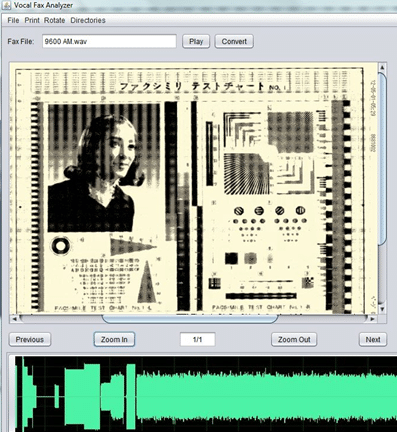
T.38 Fax Image Decoding allows an application to obtain a facsimile image from a previously recorded file and real-time sniffer T.38 Fax over IP data streams. The software library supports fax image extraction and decoding for both high speed (V.34) and low speed (V.17 and below) fax transmissions over T.38. When paired with VOCAL’s Facsimile Lawful Interception library, this combination of fax demodulation and decoding software provides developers a foundation for a range of lawful intercept (LI) possibilities with facsimile monitoring, interception, frame capture and recording.
VOCAL has substantial experience with FoIP lawful intercept and recording technologies and can advise developers in the proper configuration of your recording system. For important recordings with incomplete or damaged capture files, manual intervention may be able to recover some or all of the relevant data. Contact us for a demo.


VOCAL’s T.38 fax decoding software is optimized for DSPs and conventional processors from TI, ADI, ARM, AMD, Intel and other leading vendors. Custom designs are also available. Our extensive experience with fax design, implementation and configuration will help you select the right solution for your T.38 fax decoding application.
Fax Modulations and Protocols
Support for both high speed and low speed Group 3 Fax modulations:
- ITU V.34 Half-duplex
- ITU V.8 – V.34 capabilities negotiation
- ITU V.17 – 14,400, 12,000, 9600 and 7200 bps with trellis encoding
- ITU V.29 – 9600, 7200 and 4800 bps
- ITU V.27ter – 4800 and 2400 bps
- ITU V.21 Channel 2 – 300 bps
Supported Protocols:
- ITU T.38 for Real-Time Group 3 Fax/Facsimile Relay over UDP/IP networks
- UDPTL T.38 packetization support
- RTP T.38 packetization support
- T.30 Group 3 Facsimile Timing and Control Procedure
- T.30 Error Correction Mode (ECM)
- T.4 One and two dimensional (MH and MR) fax image decoding procedures
- T.6 MMR Image Format Conversion
T.38 Fax Decoding Software Features
- Extract and decompress page data to viewable image files
- Information about extracted pages is provided to the user
- Automatic detection and extraction of T.38 fax images
- Partial page output may be available even if recordings are partial or damaged
- Support for real-time processing on a continuous stream and pre-recorded data
- Automatically classify FAX traffic by modulation and non-standard or custom types
- Half duplex extraction support
- Automatic and forced detection of non-standard signaling
- Extract fax images in auto, manual and polling modes
- Support for libpcap network traffic captures
- Support for Windows and Linux operating systems, as well as embedded system platforms
- Available as an executable or library (.dll/.so)
More Information
Platforms

VOCAL’s optimized software is available for the following platforms. Please contact us for specific T.38 fax decoding supported platforms.
| Processors | Operating Systems |
|---|---|
|
|