
VOCAL’s Microphone Noise Reduction software solutions are used to enhance the speech quality of the captured audio. This software is used in military, industrial and commercial applications such as cockpits, call centers, and other challenging acoustic environments that can interfere with effective voice communications.
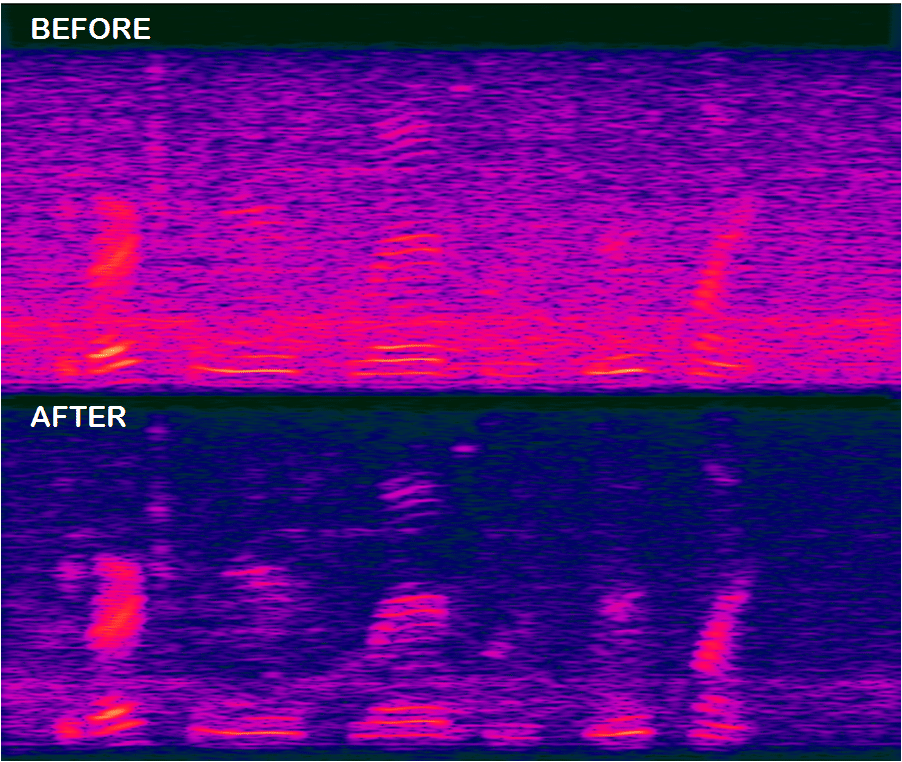 The features of our Microphone Noise Suppression software solutions include:
- Improves Speech Quality
- Quickly adapts to time-variant noise characteristics
- Built-in tone attenuation
- Click-noise removal option available
- Portable, re-entrant and re-locatable library code
- Supports user callable functions
- 16-bit and 24-bit depths supported
- Supported sampling rates: 8kHz to 48kHz
- Low complexity, optimized for ANSI C and leading architectures
Microphone Noise Reduction Software
VOCAL’s noise reduction software may be licensed standalone, as a library or part of a complete design with VoIP or as part of our Voice Quality Enhancement and Acoustic Echo Cancellation solutions. Our software libraries are optimized for leading DSPs and microprocessors from TI, ADI, Intel, AMD, ARM and other vendors.
Our noise suppression software can serve as a preprocessor for Forensic Speaker Identification systems. By attenuating the noise and preserving the speech, the identity of the speaker can be more accurately identified. In addition, this software can serve as a front-end to VOCAL’s Battlefield voice activated detection / transmission module. The output of this function can be used for noise gating.
VOCAL also offers multi-microphone noise reduction software solutions. Multiple microphone systems provide additional spatial and reference noise information not available to single microphone systems, more information on these types of solutions can be found here.


VOCAL’s noise solutions can be customized for your specific voice communications application needs, please Contact Us to learn more.

VOCAL’s solution is available for the above platforms. Please contact us for specific supported platforms.