
VOCAL’s VPBX Home Gateway Reference Design supports VoIP telephony applications for the SOHO. It exemplifies a standards-based next-generation product, with an extensive features list, world-wide configurability, multilingual support, and simple upgrade/expansion paths. Our Reference Designs far surpass the competition in terms of cost advantage and time-to-market potential, achieving scalable channel density while supporting easy integration of new feature modules. Contact us for a demo.

VPBX Home Gateway Features
Complete listings of all the features and technical specifications are available. Highlights of the VPBX Home Gateway Reference Design include:
- WAN support (10/100 ethernet, cable modem or DSL) and WLAN support
- Multiple line support for FXS and FXO ports with multiple ethernet ports
- SIP and/or MGCP support with multiple VoIP providers
- Encrypted communication using secure RTP (SRTP) with SDES or proprietary key negotiation
- Network stack with NAT/firewall support
- Voice codecs such as G.711, G723.1, G.726, G.729AB, MELP, and iLBC vocoders
- High performance G.168 echo canceller
- An extensive set of telephony features
- Call progress tones with world-wide configurability
- Ringing patterns with multiple ringing tones, message waiting (tone/ring/visual), etc
- Quality of service configurability
- Flexible configuration and provisioning options
- Multilingual Web configuration via built-in Web server and hierarchical user levels
- Mass production support for flashing code image, firmware configuration, and testing
- Remote administration and firmware update
- Power-off/911 service failover
VPBX Home Gateway Design
VOCAL’s VPBX Home Gateway Reference Design details an example of an innovative Voice over IP-PBX product which uses HPNA and an Internet connection to meet all the telephony needs of a home or small office. It is composed of the VPBX Home Gateway Unit (VHGU) and the VPBX Extension Device (VED). The VHGU is the central controller, handling all networking and voice/telephony processing as HPNA connectivity to VED endpoints. The VEDs are minimal POTS interfaces that may be placed anywhere on the HPNA network. Calls are placed from the VEDs through the VHGU to external parties as appropriate for the type of call.
We have over 25 years of custom design and development experience in the telecommunications industry, our expertise and extensive customization support will result in the product you want at an unbeatable cost. Since VOCAL provides both the hardware design and a complete, optimized software solution, the result is a fully integrated, robust product which can be brought to market quickly.
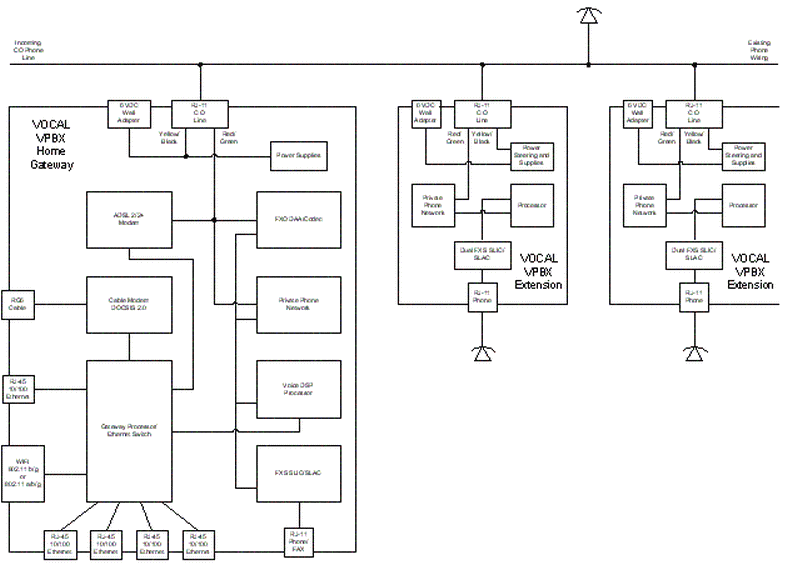
Figure 1. VOCAL VPBX Home Gateway System
Home Phoneline Networking Alliance (HPNA)
HPNA technology allows for new multimedia services such as IPTV and VoIP to be brought into the home without requiring new wiring. Existing phone lines and coax cables are used to provide high-speed data rates of up to 320 Mbps. This makes a wide range of home networking functionality available at low cost, such as whole-home IPTV, PVR, DVR, HD video, etc. Voice, video, and Internet access provided by fiber, DSL, wireless, and satellite sources can be easily distributed throughout the home or multiple-dwelling unit (MDU) using HPNA.
The HPNA-based VPBX system allows a homeowner to use any phone in the house to access their VoIP calls. Moreover, the VPBX permits seamless access to the original telephone company PSTN line and up to 4 different VoIP service providers. VOCAL’s Concurrent VoIP ™ technology allows one of these service providers to be MGCP-based while the others may be SIP-based. The VPBX system also supports station-to-station dialing and paging within the home environment.